



The difference between a 2× ROAS campaign and a 12× ROAS campaign is usually one creative.
Not the product. Not the targeting. Not the budget. The creative that either stops the scroll and converts, or doesn’t.
Finding that creative requires testing. And most ad accounts don’t test enough, because producing enough variants is slow and expensive, and most businesses don’t have a systematic framework for what to test, in what order, and for how long.
Here’s the framework.
Why Most Creative Testing Fails
The most common creative testing mistakes, and why they produce bad data:
Testing too few variants. Running 3 creative variants and declaring a winner is like sampling 3 candidates for a job when the best person for the role wasn’t interviewed. The winner in a 3-variant test is the best of 3, not the best possible. With 20 variants, you’re finding a real winner.
Testing multiple variables at once. Changing the image, the headline, and the CTA at the same time means you can’t know what drove the difference in performance. If Variant A outperforms Variant B, is it the image? The headline? You can’t tell. Test one variable per experiment.
Stopping tests too early. A creative that’s performing well in the first 48 hours might be doing so because of platform learning bias, not genuine performance. Stopping before statistical significance produces false winners that fall apart when you scale.
Not having enough budget per variant. Splitting $500 across 10 variants gives each variant $50, which isn’t enough data to reach any conclusion. Budget allocation needs to match the testing structure.
The 4-Phase Creative Testing Framework
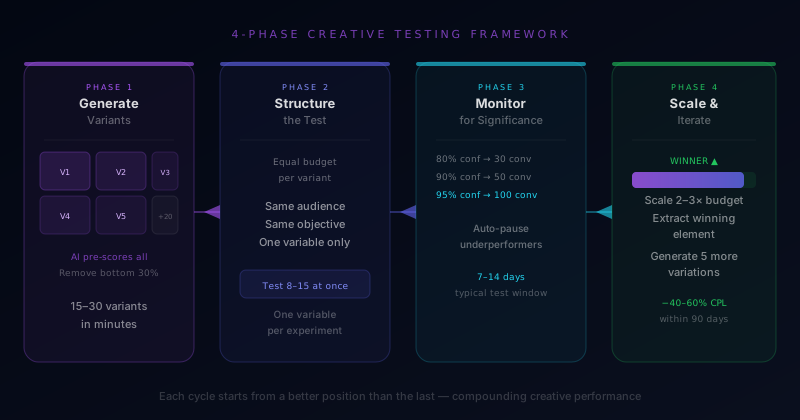
Phase 1: Generate Multiple Variants
The test starts with volume. Before launching a single ad, you want 15–30 creative variants ready, covering different images, different headlines, and different angles on the same core message.
AI creative generation makes this feasible without a proportional increase in production cost. One brief, covering brand, copy direction, target audience, and platform, produces 20+ variants in minutes, each pre-scored for predicted performance.
Pre-scoring doesn’t eliminate testing. It does eliminate the worst performers before they spend any budget. If the AI predicts 8 variants will underperform based on patterns from comparable campaigns, you can launch the top 12 and skip the budget waste on the bottom 8.
Phase 2: Structure the Test
Not all 20 variants go live simultaneously. The testing structure depends on your budget:
- Low budget ($1,000–$3,000/month): Test 3–5 variants at a time, cycle every 2 weeks
- Mid budget ($3,000–$15,000/month): Test 8–12 variants simultaneously, cycle weekly
- High budget ($15,000+/month): Test 20+ variants, use AI to automatically pause underperformers in real time
Each variant gets equal budget in the test phase. Equal conditions are essential, because any budget advantage will distort the result.
Phase 3: Monitor for Statistical Significance
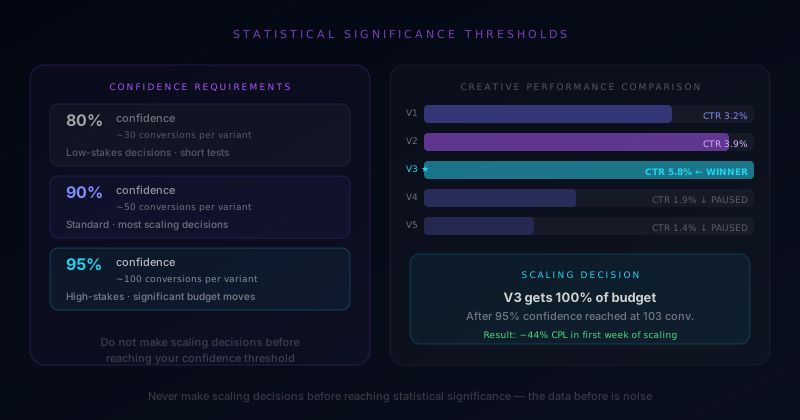
The test runs until each variant has generated enough conversions to reach statistical significance. The threshold depends on your confidence requirement:
- 80% confidence: ~30 conversions per variant (acceptable for low-stakes decisions)
- 90% confidence: ~50 conversions per variant (standard for scaling decisions)
- 95% confidence: ~100 conversions per variant (required before significant budget reallocation)
Don’t make scaling decisions before reaching your confidence threshold. The data before significance is noise, not signal.
Phase 4: Extract, Scale, and Iterate
Once a winner is identified:
- Scale the winner, increasing budget 2–3× while pausing underperformers
- Extract the winning element, identifying whether the performance driver was the image, the headline, the angle, or the CTA
- Generate variations of the winner. If a specific image style won, generate 5 more variants with the same style and test again
- Set a refresh cadence, because even winning creatives fatigue. Plan a new test cycle before performance declines
Each cycle starts from a better position than the last because you’re building on data, not guessing.
What Systematic Testing Produces at Scale
A client who enters with a 3-variant ad account and moves to a 20-variant systematic testing framework typically sees:
- 40–60% reduction in cost-per-lead within the first 90 days
- 3–5× increase in the number of profitable creative concepts running simultaneously
- A predictable creative pipeline, with tested variants always ready to replace fatiguing ads
At CreativeComplete, creative testing is embedded in the AI Creative Engine. AI generates the variants, pre-scores them, manages the test structure, and automatically scales winners while pausing underperformers. The entire process runs without requiring your team to manually monitor ad performance or make creative decisions under uncertainty.
The goal is a creative operation where you always know what’s working, why it’s working, and what to test next.
For the complete production system — variant generation at scale, performance scoring, multi-platform deployment, and brand locking — read the AI Ad Creative Production Guide.